.avif)
House Recladding Cost in NZ (2026): What Aucklanders Actually Pay
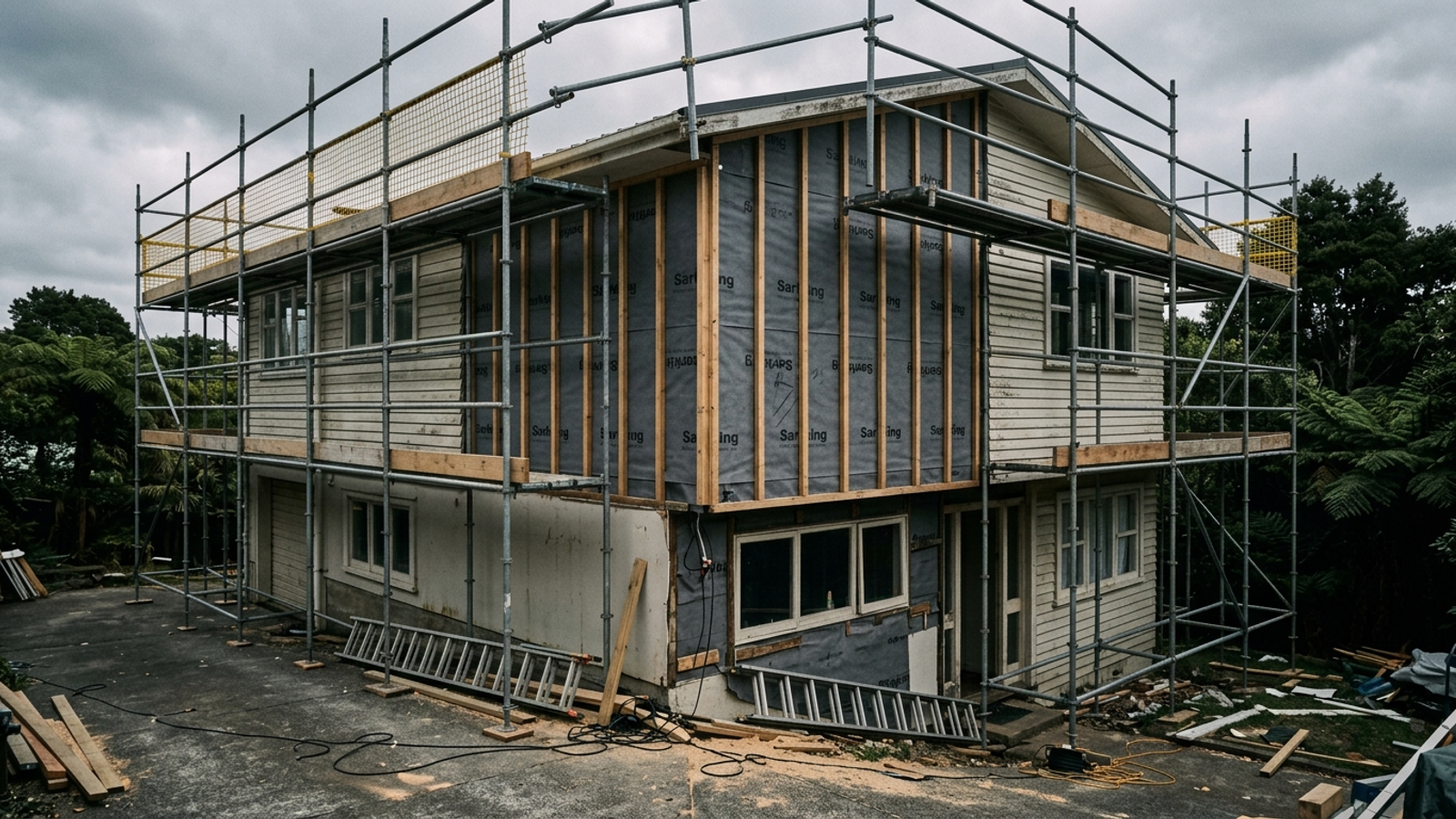
Recladding is the renovation nobody wants and some homes genuinely need, especially monolithic-clad houses from the 1990s and early 2000s. Here is what a reclad really costs in 2026 and where the money goes, from a builder's side of the scaffolding.
In this guide
What a reclad costs (2026)
| Scope | Typical cost | Notes |
|---|---|---|
| Targeted reclad (one elevation / problem area) | $40,000–$100,000 | Where damage is confirmed localised |
| Full reclad, standard single-storey | $150,000–$220,000 | Straightforward access, minimal remediation |
| Full reclad, two-storey or complex | $220,000–$400,000+ | More scaffold, more wall, more junctions |
Where the money goes
- Scaffolding and weather protection: $15,000–$40,000, often with full shrink-wrap
- New cladding system: weatherboard, brick veneer or modern panel, over a drained cavity
- Timber remediation: the unknown. Framing repairs range from minor to structural
- Joinery: windows are usually replaced at the same time, $30,000–$80,000
- Consent, engineering and monitoring: reclads are fully consented, inspected work
Full reclad vs targeted repair
A targeted reclad makes sense when moisture testing confirms damage is localised and the rest of the envelope is performing. A full reclad makes sense when the cladding system itself is the problem. The wrong economy is patching a failing system one elevation at a time, you pay for scaffolding twice and keep the underlying risk. Get invasive moisture testing first and let the data decide.
Process and timeframes
- Building survey and invasive moisture testing
- Design, engineering and building consent
- Scaffold, wrap, strip cladding, assess framing
- Remediate timber, install new cavity and cladding, replace joinery
- Council inspections throughout, then Code Compliance Certificate
Most full reclads take 2 to 4 months on site. You can usually live in the home, the work is external, though expect noise and wrapped windows.
The short answer
Budget $150,000 to $300,000 for a full reclad of a standard Auckland home in 2026, and insist on a quote that prices timber remediation transparently per metre. A properly recladded home recovers its value and its weathertightness warranty story at sale time.
Recladding is structural, weathertightness-critical work, exactly what LBP licensing exists for. E4 Builds carries out consented remediation and renovation work across Auckland. Talk to us before the moisture gets worse.
Common questions
How much does it cost to reclad a house in NZ?
A full reclad of a standard home costs $150,000 to $300,000 in 2026, with large or complex homes exceeding $400,000. Targeted reclads of confirmed problem areas run $40,000 to $100,000. The biggest variable is timber remediation found once the old cladding comes off.
Can you live in your house during a reclad?
Usually yes. Reclad work is external, so most families stay in the home. Expect scaffolding, wrapped windows, and noise during working hours for 2 to 4 months.
Can you reclad a house yourself in NZ?
No. Recladding is Restricted Building Work, structural and weathertightness critical, so it legally must be carried out or supervised by a Licensed Building Practitioner, under a building consent with council inspections.
How long does a reclad take?
Most full reclads take 2 to 4 months on site, after design and consent. Add 2 to 3 months up front for testing, design, engineering and Auckland Council consent processing.
Is it cheaper to reclad or render over existing cladding?
Rendering over a failing cladding system does not fix moisture ingress, it hides it. If the envelope is failing, recladding over a drained cavity is the repair that restores the home's value; render is a finish, not a fix.